

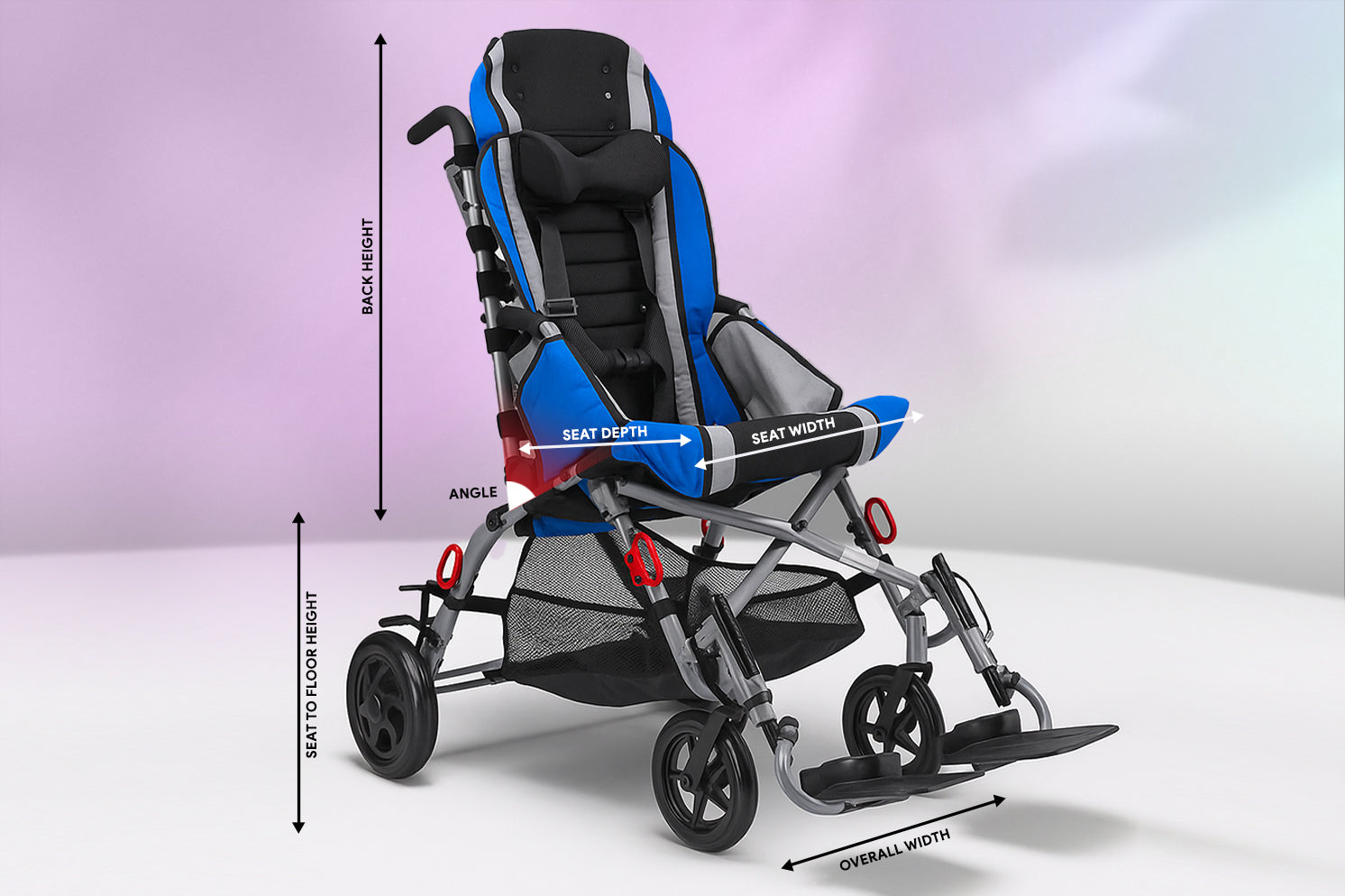
To measure your child for a special needs stroller, use a firm, armless chair and record five points: weight, seat width, seat depth, back height, and lower-leg length. Then match each number to the model’s spec sheet so the seat width, depth, back support, and footrest height line up correctly. This keeps your child supported and comfortable, meets unique needs like head or trunk control, and leaves room to grow.
This article explains:
-
Why accurate measurements matter.
-
Preparation and planning.
-
Step-by-step measurement guide.
-
Interpreting your numbers and sizes.
-
Planning for growth
-
Common measurement mistakes.
Why Accurate Measurements Matter
If your choice of sizing is correct, your child will have perfect comfort for everyday use and also the proper posture that helps with healthy spine alignment and reduces fatigue. Also, your child is safer when they sit correctly, thanks to a secure harness fit and by avoiding dangerous sliding or slumping in transit.
And, of course, a correct sizing and fitting of your stroller will also have immediate financial consequences, as funding sources and insurance providers require some level of documentation of medical necessity and appropriate fit. Incorrect fitting can sometimes invalidate warranty claims and may force you to cover the costs of expensive repairs and replacements. That’s why most manufacturers require that you validate the warranty by having a professional confirm the fitting.
Finally, an exact and proper fit preserves long-term value. Equipment that fits well is subjected to less wear from being positioned incorrectly and lasts better over time. When your child eventually outgrows or no longer needs the stroller, properly fitted equipment retains higher resale values, making the significant up-front investment more affordable for future mobility needs.

Prep: Tools, Posture & Environment
The key to sizing your stroller up correctly comes from preparation and planning. Your measurements and alignment must mirror clinical measuring standards that are mandatory in medical supply facilities.
Essential Tools
Have a rigid edge (book or ruler) for straight measurements, a flexible cloth tape for circumferences, a clipboard or phone for notes, and a helper for positioning. Use a firm, armless chair.
Optimal Positioning
Ensure your child is in the correct front posture position, with their feet flat on the floor and knees at 90 degrees. Your child should appear to be in a relaxed position with normal spinal curvature. Remove bulky clothing and jewelry that add size, and keep usual footwear or AFOs on for leg measurements so the footrest height matches real life.
Environmental Considerations
Be sure to use a quiet and relaxing room environment that avoids any distractions and reduces fidgeting behavior. Familiar environments allow anxious children to collaborate more effectively. Keep the entire measurement session short, no longer than 10 minutes, to maintain motivation and prevent tiredness that could lower positioning accuracy and measurement reliability.
Step-by-Step Measurement Guide
Here are five steps to consider when measuring your child for a precise stroller fitting. They offer comfort, safety, and therapeutic positioning.

Seat Width
Start by measuring the widest part of your child, across their thighs and hips, when seated in the proper sitting position. Use your rigid ruler to measure this width from the outer extremities of each hip. Add an additional half-inch of room for when wearing winter clothing, heavy braces, or layering for the season without loss of comfort. This width prevents annoying pinching without keeping the child from sliding during transportation. Mark this as your minimum seat width requirement, keeping in mind that excessive width compromises lateral stability and back support.
Seat Depth
Measure from the back of the buttocks to the back of the knee, keeping a 90-degree angle. This measurement indicates the distance from the front of the seat to where the child sits. Subtract one full inch from this length to stop the edge of the seat from cutting into the calf area, as this will restrict circulation and become painful when being used for an extended period. Proper seat depth will spread the child’s weight across the thighs and maintain an adequate blood flow to the legs.
Back Height
Begin at the rear bottom of the seat base and measure vertically upwards to the child’s shoulder line. This value will give you the length for standard back support. If your child requires head positioning support due to low muscle tone or head control, measure to the top of the head instead. Measure to the shoulder line for standard support, or to the top of the head if head support is required; this helps set posture and select headrest options.
Lower-Leg Length
Keep the child’s knees at a 90-degree angle, and measure from the bottom of the foot to the back of the knee. This height will give you the ideal placement of the footrest to prevent swelling in the legs and to ease circulation. Proper footrest height eliminates pressure points beneath the thighs while providing stable leg support that is part of general postural stability and comfort on longer outings.
Trunk Width
Measure your child across the chest to get the lateral support level. This measurement also informs you of the side supports, chest harness, and trunk positioning accessory sizing. Trunk width is measured accurately to make sure that the lateral support provides proper guidance without restricting breathing or daily arm movement.
Interpreting Your Numbers & Standard Sizes
The manufacturers of special needs strollers categorize their products into standard size brackets, rather than exact measurements. A seat width that measures 12 inches, for example, would fall into the size chart described as “fits 10-14” hip width.” By using this measurement, you have some small leeway in the sizing whilst making sure of a good fit across the size range. Always select the bracket that comfortably covers your child's measurement without reaching towards the high ends.
Do not exceed the manufacturer's weight rating, regardless of how well other sizes fit. Weight ratings are equivalent to structural engineering design and safety test standards. Exceeding these can result in possible equipment failure, injury, and immediate warranty voidance. Also, take into consideration the static non-moving weight and the weight when considering movement.
| Size Category | Seat Width Range | Weight Capacity | Typical Age Range |
|---|---|---|---|
| Infant | 8" – 12" | Up to 50 lbs | 6 months – 3 years |
| Child | 10" – 16" | 50 – 125 lbs | 2 – 8 years |
| Junior | 14" – 20" | 100 – 200 lbs | 6 – 14 years |
| Adult | 18" – 24" | 200 – 350 lbs | 14+ years |
Planning for Growth & Adjustability
When purchasing a stroller, consider your child’s growth and development, as this will impact the sizing over time. Invest in an adjustable stroller frame to achieve maximum equipment value and lifespan. If you choose models with adjustable seating depth and back height expansion kits, they will accommodate natural growth patterns without requiring complete equipment replacement.
Use the two-inch rule: select frames with a minimum of two inches of seat depth extension beyond existing sizes. This buffer will accommodate average annual growth while allowing correct positioning. Also, have a 15-20 pound weight capacity buffer over your child's current weight to ensure safe use as they grow.
Common Measurement Mistakes
These are some typical measurement errors, which are harmful to the stroller’s comfortable fit and its safety:
-
Measurement on soft surfaces - If your child is sitting on a sofa or a padded chair, their posture will be inaccurate, and your measurements will be deceptive.
-
Leaving out footwear space - Always take into account the space for shoes, AFOs, or foot braces in footrest calculations.
-
Excessive rounding - Avoid adding excessive space above recommended allowances, as this reduces postural support.
-
Non-measurement of orthotics and braces - Take into consideration any equipment your child might be using, including back braces, hip supports, or positioning devices.
-
Being in a rush - Avoid measuring your child when they are feeling tired, agitated, or not well-positioned within the stroller, as this can lead to inaccurate results.
-
Use of flexible rulers - Use rigid, non-bendable rulers. Flexible rulers can lead to mistakes in measurements.
When to Re-Measure
Make sure to measure your child regularly to keep them safe, comfortable, and well-positioned in their stroller. Schedule re-measurement appointments during routine or annual medical check-ups, or when your child has grown by 1½ inches. Orthotics, braces, or post-surgical orthotics must be re-checked immediately to provide adequate support and comfort. And if your child experiences any significant weight changes of 15 pounds or above, then new measurements will need to be taken.
Confirming the Fit & Next Steps
Free Video Consult With Our Product Specialists
Bring your measurements, weekly routes, and any therapist goals. Our specialists review model options, explain fit features, and double-check numbers on camera.
At-Home Fit Check With 30-Day Returns
Use your daily routes, curbs, store aisles, bus ramps, car loading to verify real-world fit. If it is not right, we will help you exchange the model within the return window.”
Key Takeaways
Through this guide, we hope you have found all of the information you need to properly measure and fit your child for their special needs mobility stroller. Use and keep this information for future reference when remeasuring, adjusting, or purchasing an updated stroller.
Got your numbers? Explore our Special Needs Strollers Collection to find a model that fits today and has room to grow.
If you need help selecting the right stroller, our friendly staff is always ready to assist you via online chat or by phone call to provide you with personalized fitting advice.
Frequently Asked Questions
I’ve taken my child’s measurements. How do I turn those numbers into a shortlist of strollers?
Compare your measurements with the stroller’s specifications to determine the correct weight capacity, intended terrain use, and adjustability options. Consider possible growth changes and your daily surroundings. Check our extensive Adaptive Stroller Buying Guide for more information.
The correctly sized stroller feels expensive. Can insurance or FSA/HSA funds help cover the cost?
Medical insurance policies with documentation cover the majority of medically necessary mobility equipment. FSA/HSA funds will usually qualify for prescribed gear. Check coverage requirements and documentation requirements in our Insurance & Funding Guide.
We plan to travel soon. Are there specific airline rules regarding stroller dimensions?
Many airlines allow gate-checking for strollers; policies vary by carrier and route. You can prevent damage to your stroller during travel with protective travel bags. Check specific airline policies and packaging regulations in our Travel Safety Checklist.
Which accessories help keep my child comfortable during more extended periods of stroller use?
There are many features and accessories available, including lateral support pads, calf cushions, adjustable headrests, sun canopies, sensory covers, and seat liners for temperature regulation. Check our Positioning & Comfort Tips for inspiration.
How can I keep the stroller fitting properly as my child grows?
Check your stroller seat depth and clearance each month, along with harness tension adjustments, and monitor growth patterns and weight changes for timely adjustments. Refer to the detailed maintenance schedules in our Care & Maintenance Checklist.


