

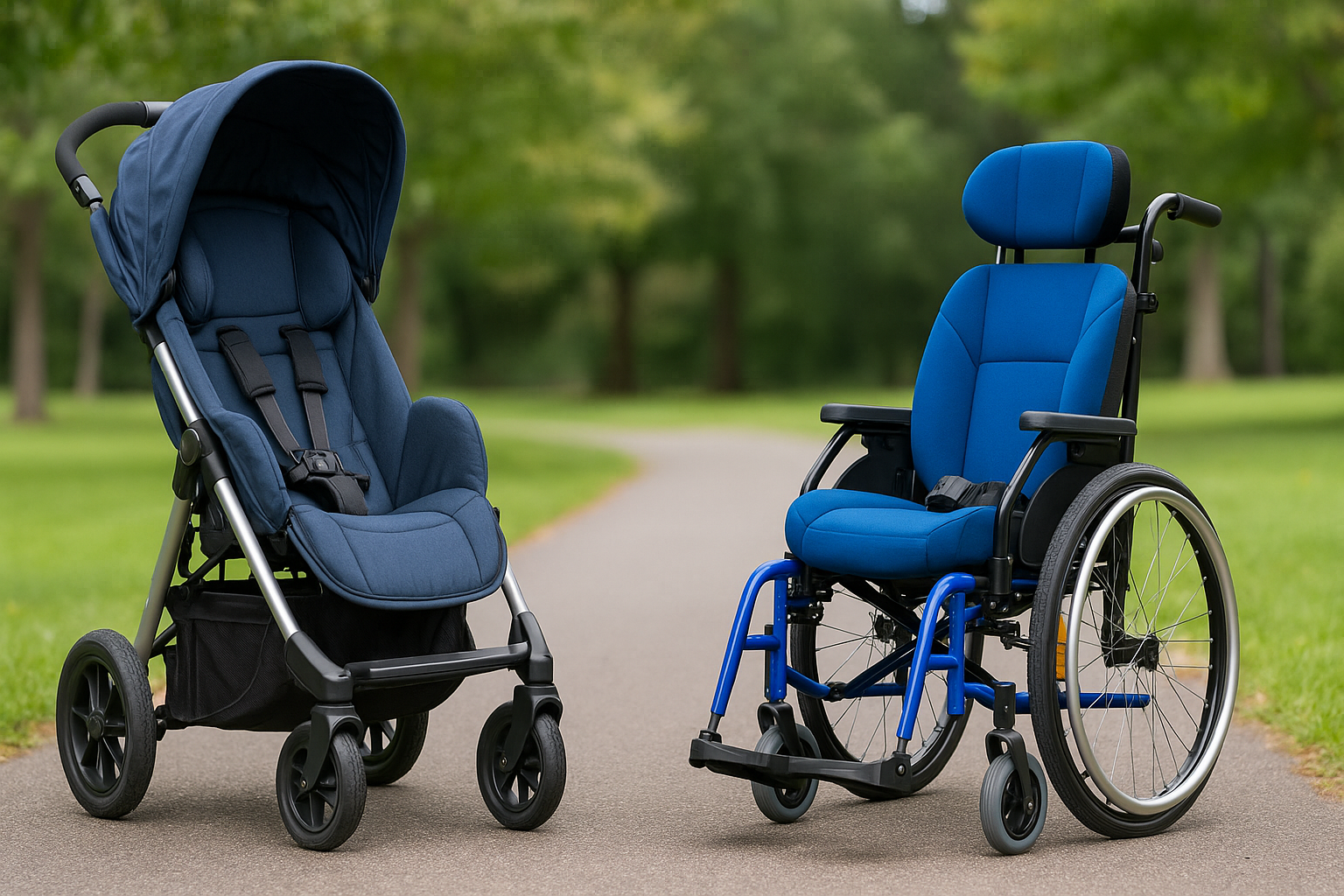
Special needs stroller vs pediatric wheelchair, which do you need? Special needs strollers are different from pediatric wheelchairs. They fold down in a different way, and the support they offer is different from that of a pediatric wheelchair. They also adjust differently to a growing person. Many people struggle to find the right option for their needs.
Here is a helpful description of each type of vehicle and how each choice best serves your child’s current needs regarding future mobility goals, proper positioning, and travel needs. We also discuss how and when insurance covers these expenses.
At a Glance: Stroller vs Wheelchair
To understand the fundamental differences between special needs strollers and pediatric wheelchairs, you have to look at what each one does and what they each offer.
Special needs strollers are compact, travel-efficient, and durable with upper body support and full body positioning of one's own choosing. Wheelchairs offer more independence and can be customized to future needs as the child grows and develops.
The helpful list below highlights the main differences to consider when you choose between the two:
Special Needs Stroller Pediatric Wheelchair
|
Primary Purpose |
Caregiver-pushed transportation and outings |
Independent or assisted daily mobility |
|
Who Propels |
Always caregiver-pushed |
Can be self-propelled, caregiver-pushed, or power-assisted |
|
Posture Support Level |
Moderate to high support with built-in positioning |
High customization with specialized seating systems |
|
Adjustability Options |
Basic growth adjustments, limited customization |
Extensive customization for individual needs and growth |
|
Transport and Fold |
Quick fold, lightweight, car-friendly |
Varies by model; some fold, others require vehicle lifts |
|
WC19 Transit Seating |
Limited WC19-compliant models available |
Many models meet WC19 standards for vehicle transport |
|
Typical Use Cases |
Errands, travel, recreational outings, short distances |
School, daily activities, long-term mobility, therapy |
|
Growth Pathways |
2-5 years typical lifespan, then a transition is needed |
Can accommodate growth for many years with adjustments |
|
Coverage Notes |
Often covered as durable medical equipment |
Usually covered with proper medical justification |
Choose by Goals and Daily Needs
If you are torn between special needs strollers and pediatric wheelchairs, think about your daily routine and how a vehicle will make it better. Consider where you spend the majority of your time and what mobility issues you encounter daily.
Short caregiver-pushed outings and community access
Special needs strollers are great for errands, school drop-offs, doctor's appointments, and trips to the park. Opt for a stroller if you frequently need to fold equipment for car transport, navigate tight store aisles, or make multiple car runs. Their portable, light design is great for families who need convenience for short outings in the community.
Independent mobility and self-propulsion
Pediatric wheelchairs help children develop self-propelling skills with manual wheels or prepare for joystick controls and power assist features. They offer durable, all-day seating systems that encourage independence and proper positioning during extended use. They are ideal for children ready to manage their own mobility.
School, therapy, and community transport needs
Consider wheelchairs for tie-downs on school buses, transfers within the clinic, and therapeutic positioning daily. Transit-approved seating systems meet transportation safety requirements and provide stable support for therapy sessions, classroom activities, and extended school days.
Posture, Positioning, and Clinical Needs
Your child’s comfort and safety start with good posture. Pediatric wheelchairs and special needs strollers both require adaptive support for postural position. The choice depends on the health condition to determine which provides the best positioning control.
Head, trunk, and pelvic support requirements
Special needs strollers offer basic lateral supports with pelvic belts and adjustable headrests, with 5-point restraints for extra security.
Pediatric wheelchairs offer more complex and sophisticated positioning with adjustable lateral thoracic supports, hip guides, and modular headrest systems that support complex postural needs and growth.
Tilt in space, recline, and pressure management
Tilt-in-space keeps hip angles but redistributes pressure, a benefit for those with tone deficits or pressure difficulties. Wheelchairs offer a greater range and precision than stroller systems.
Seizure safety, tone fluctuations, and equipment mounts
Wheelchairs are more stable for seizures with a more rigid frame structure and safer strap routing. Both systems accommodate medical equipment mounts, but wheelchairs provide more mounting points and room for weight on ventilators, feeding pumps, and communications aids.
Portability, Storage, and Travel
A key consideration is how the choice of vehicle impacts your travel needs and preferences. How easy are they to carry and store on cars, trains, and airplanes?
Fold size, lift weight, and car loading
Special needs strollers fold 30-40% more compact than wheelchairs and are 15-30 pounds lighter. Strollers are great in small cars, while wheelchairs require larger ones or must be foldable.
Bus and van securement; WC19 seating vs vehicle car seats
WC19-rated wheelchairs are secured to bus/van tie-downs and have crash-tested seat systems. Special needs strollers require the child to be transferred to a vehicle seat with the right child car seat. Wheelchairs are ideal for public transit, while strollers work best for use in private vehicles.
Airports, gate-check basics, and protection in transit
If you are traveling, measure the folded dimensions and weight before your journey to make sure it fits with the airline's recommendations and requirements. Upon arrival at the gate, ask for check tags for larger items. As a general rule, strollers can fold up smaller to go in overhead bins, but wheelchairs might need gate checking.
Sizing and Growth Planning
The size of the special needs stroller or pediatric wheelchair matters. It will prevent slumping, pressure points, and possible discomfort. The proper sizing maintains therapeutic positioning and supports the child's growth.
Key measurements to check
Check the child's weight, chair width (hip-to-hip plus 1"), seat depth (back of knee to buttocks), back height (seat to shoulder blade), and lower-leg length (seat to heel).
Adjustability ranges and growth kits
More seat depth allows for a child’s growth, and avoids pressure on the knees; extra back height range accommodates a growing torso. Strollers usually offer 2-4" ranges of adjustment, and wheelchairs come with modular growth kits that provide 12-18 months more use than fixed-size frames.
When to re-measure and resize
Re-measure every 6 months for children under the age of 5, annually for older children. Resize as soon as possible if the position changes, if there are signs of pressure, or if the child surpasses the weight limits.
Cost and Coverage Pathways
There are different funding means for both pediatric wheelchairs and special needs strollers. Coverage depends on plans and states.
Private insurance and Medicaid routes
Use licensed medical suppliers (LMN) with correct HCPCS codes. Private insurance usually requires prior authorization; Medicaid's EPSDT program is responsible for medically necessary equipment for kids. Documentation from a therapist and physician supports the claim for both mobility options.
Grants, FSA or HSA, and community fundraising
Foundation grants, flexible spending accounts, and crowdfunding can cover the unmet areas of insurance benefits.
Total cost of ownership and resale considerations
New equipment comes with warranties and professional fitting help. Pre-owned options are more affordable but may lack coverage and adjustment.
Try Before You Decide
Always trial test equipment properly and get expert advice before you buy. Professional advice alongside real trials means that you can find the right mobility solution for your child's needs.
Free consult and model shortlisting
It is a good idea to have your child’s measurements, mobility goals, and images of typical terrain before you book an appointment. This will define the type of vehicle you are looking for so that you can focus on which one works best.
At-home fit checks and return-window best practices
Ask for real-world trials on everyday routes, local roads, stores, and cars. During these runs, assess positioning, agility, and use situations to verify the vehicle meets your child’s needs and expectations. Make sure to check the return policies, in case you want to return the vehicle.
Myths and Real Talk
There are three myths that we need to dispel.
Wheelchairs are only for permanent use
Wheelchairs are not a flag of surrender; they are participation aids. They give independence and help with school attendance and community engagement.
Strollers are not durable enough for daily needs
Heavy-duty special needs strollers can handle a lot of weight and different types of ground. Wheelchairs are ideal for older kids who require self-propulsion and independent transfers.
Transit labels are not necessary
It is true that transit labels are not universally required for wheelchairs or special needs strollers. However, certain circumstances and transit agencies may have specific requirements or recommendations.
For example, some devices are designed and tested for use on school buses or vans and come with a manufacturer's label indicating they are "transit approved." Some districts or agencies require such a label for safety reasons.
Decision Matrix and Next Steps
|
Child Size |
Posture Need |
Daily Hours |
Transport |
Suggested Option |
|
Under 50lbs |
Minimal |
<4 hours |
Car seat OK |
Stroller |
|
50-100lbs |
Moderate |
4-8 hours |
Mixed needs |
Both options |
|
Over 100lbs |
Significant |
>8 hours |
Vehicle tie-down |
Wheelchair |
If you are looking into special needs strollers or wheelchairs, here is a helpful outline of some popular options. Ask us for a personalized quote so that you can look at features and prices.
For more information and a price guide, visit our site:
You could also find the following helpful:
-
https://shophomemed.com/products/smilez-pediatric-wheelchair
-
https://shophomemed.com/products/coche-xl-lightweight-special-needs-stroller-transport-chair
____________________________________________________________________________
Frequently Asked Questions
Is it okay to start with a special needs stroller now and transition to a wheelchair later?
Yes! Most families with younger children begin with strollers, then transition to wheelchairs as their child becomes more independent and requires more activity.
Will insurance cover a stroller or a pediatric wheelchair?
Insurance generally covers medically necessary pediatric wheelchairs with orders and documentation. Strollers are not usually covered because they are considered convenience items and not durable medical equipment.
How can I tell if my child is ready to push a wheelchair independently?
They should have upper body strength and the cognitive ability to learn steering/braking. If they have a longing for independence, a wheelchair will certainly meet their needs and expectations. Occupational therapists can assess your child’s readiness and prescribe the right wheelchair features for successful self-propulsion.
We travel often. What's more convenient for planes and buses, a stroller or a wheelchair?
Strollers are more compact for overhead storage but require transfers. Wheelchairs stay with your child but need to be gate-checked. Choose the right vehicle for your child's needs and comfort.
My child is getting older. Are there options that fit teens or young adults?
Yes! Both varieties are available in adult sizes. Heavy-duty strollers have weight capacities of 200+ pounds, and adult wheelchairs provide complete independence and mobility options for larger adults.
Sources/References
1. WC19 Transportation Safety Standards
Source: NMEDA (National Mobility Equipment Dealers Association)
URL: https://nmeda.org/consumer-resources/wheelchair-transportation-safety-wc-19/
2. University of Michigan Transportation Research Institute - WC19 Standards
Source: Wheelchair Transportation Safety Research Center
URL: https://wc-transportation-safety.umtri.umich.edu/wc19/
3. Medicaid EPSDT Program Coverage
Source: MACPAC (Medicaid and CHIP Payment and Access Commission)
URL: https://www.macpac.gov/subtopic/epsdt-in-medicaid/
4. Pediatric Wheelchair Sizing Guidelines
Source: Thomashilfen (Medical Equipment Manufacturer)
URL: https://www.thomashilfen.us/pediatric-wheelchairs-wich-dimension-important
5. Special Needs Stroller vs Pediatric Wheelchair Definitions
Source: Rehabmart
URL: https://www.rehabmart.com/post/how-to-choose-the-best-special-needs-stroller


